December 5, 2006


Mr. Snowman disregards the warning about skating on thin ice and is enjoying himself.


Help! Help! I can't swim.
Stand up and live again Mr. Snowman, God loves you.


Mr. Snowman thanks the angel once more for saving his life.


One last word before the angel ascends, Stay off thin ice.

Pictures and storyboard by Hazel.

December 4, 2006

Cast members of We Hold These Truths include Orson Welles, Rudy Vallee, Sterling Tracy, Bernard Herrmann, Edward G. Robinson, Bob Burns, Jimmy Stewart, Norman Corwin, Walter Brennan, and Edward Arnold. Seated are Lionel Barrymore, Marjorie Main, and Walter Huston.

I ran across this picture of the many radio and movie stars that were members of the cast of this show called WE HOLD THESE TRUTHS. Of course, I wondered, what was the show about. I, of course went to Google and here is what I found:


Commissioned by FDR to commemorate 150th anniversary of the Bill of Rights, this hour-long program was aired over the combined national networks (CBS, NBC Red, NBC Blue, and Mutual) eight days after Pearl Harbor. The Crosley Rating Service estimated 63 million people listened, half the US population at the time, and this was the largest audience in recorded history for a dramatic performance.

Of this program, Corwin said:
"...one of the programs that was very productive in my career - good for me, and also recognized as good for CBS, and good for radio - was on the hundred and fiftieth anniversary of the ratification of the American Bill of Rights. That happened in 1941.

"It was a program that had been suggested to the four networks by President Roosevelt. He said, 'Why don't you people get together, simultaneously broadcast a commemoration of that day?' The networks had never combined before. I was lucky enough to be invited to write, produce and direct it.

"It was accidental, an accident of the calendar. But what drama surrounded that, because the date of the anniversary was December 15, 1941. That followed, by only eight days, the attack on Pearl Harbor."

Corwin's 45-minute production came from Hollywood. President Roosevelt then spoke from the White House, and the program ended in New York, where Leopold Stokowsky conducted the Philharmonic in our National Anthem.

The program's magnificent cast included:
Corporal James Stewart, U.S. Army Air Corps, as "the Citizen." (Jimmy Stewart is today a retired General in the U.S. Air Force - he was then at the beginning of his flying career, and at the height of his fame as an actor.)

Edward Arnold (distinguished actor in many movies; you know his burly figure, his face and his voice even if the name is not immediately familiar)

Lionel Barrymore (brother of John and Ethel; "Mr. Potter" in It's A Wonderful Life and many other stage and screen roles)

Walter Brennan (remember him from early TV's The Real McCoys?)

Bob Burns (popular Arkansas radio comic of the time, who invented a silly musical instrument he called a "bazooka" - a name borrowed, later in the war, for the anti-tank weapon)

Dane Clark (solid performer starting a long career, many movies)

Walter Huston (father of John, star of Treasure Of The Sierra Madre among many others)

Marjorie Main ("Ma Kettle" in the movie series, and many other roles)

Edward G. Robinson (Rumanian-born, longtime favorite in Universal's gangster movies, and many other roles)

Rudy Vallee (the original "crooner" came from Maine)

Orson Welles (if you don't know, we don't have space to tell you!)

Address by President Franklin Delano Roosevelt from The White House,

Original Orchestral Score by Bernard Herrmann, and...

Performance of The Star Spangled Banner by The New York Philharmonic Orchestra, under the direction of Leopold Stokowski.

The story of this program is fascinating:
In the fall of 1941, President Franklin D. Roosevelt faced a world in great turmoil. The Nazis had overrun most of Europe, and it looked like they might soon conquer Russia. In the Pacific, the Japanese had invaded China and were brandishing a powerful, modern war-machine. FDR suggested that the 150th anniversary of the ratification of the Bill of Rights would be an excellent occasion for a powerful presentation of America's fundamental message to the world.

Norman Corwin's achievements in the art of radio drama made him the obvious choice to create a special radio broadcast, and the President's suggestion came to him, through the U.S. Office of Facts and Figures. Corwin wrote a script, assembled a "million-dollar cast" of major stars, and commissioned Bernard Herrmann to create an original score for symphony orchestra.

Then, just 8 days before the broadcast, the Japanese attacked Pearl Harbor, and the United States was at war.

Norman Corwin has told us the following:
"I still had some of the script to finish when I boarded the train in New York to go out to Hollywood for the broadcast. I worked in my compartment, and finished by the time we got to - near St. Louis, I think.

"Coming out into the aisle, I went to find the Conductor and get a radio. Orson Welles was producing one of my plays in Chicago that evening, and I wanted to hear how it went. In those days, you could rent a radio on trains; it was a small portable unit. You unwound a wire antenna in the back and stuck one end of the wire up on the train's window with a little suction cup.
"I found the Conductor but he told me there were no radios available. 'Haven't you heard?' he said. 'The Japanese have attacked Pearl Harbor in Hawaii.' Friends of mine, Mr. & Mrs. Herbert Marshall, happened to be on the same train, and I went along to their compartment where we listened to the news reports for several hours, until it became obvious that no new information was available for the moment.

"Going back to my compartment, I got out my portable typewriter again and began to revise the script. I added several things in the text, and polished some other areas, but did not change the basic thrust of the program. When I got off the train in Los Angeles, it was done."

After the broadcast, Corwin waited for the control-room telephone (his primary barometer of audience reaction) to ring. It was silent. After a long time, there was one call - a woman friend, inviting him to a party. He went to bed that night convinced that the massive undertaking, with its million-dollar cast, had been a failure.

The next morning, like Howard Koch after the War Of The Worlds broadcast, Corwin woke up to headlines. The program was acclaimed from coast to coast. It developed that people were unsure of where to call, since different parts of the program had originated from Hollywood, Washington, and New York.

We Hold These Truths would be fascinating for its historical aspects alone, but beyond that, it remains a brilliant exposition of the principles on which the United States was founded, gripping and intensely relevant after more than half a century. It has been named to the National Recording Registry as one of the the programs which is most "culturally, historically, or aesthetically significant", by the Librarian of Congress.

December 2, 2006

Sometimes I read, or hear a word or a sentence, or perhaps a paragraph that describes something in a way I have not heard, or read before. This time it was my wife who was reading a book titled WIVES BEHAVING BADLY by ELIZABETH BUCHAN, who brought this paragraph to my attention as she was taken with it, as was I when I read it. It describes an ex husband named Nathan who is still more friendly with his ex wife than his current, and he enjoys her company as does she his. Any more of the story is irrelevant as this paragraph of his dying in her living room as they visited is the wording I want to pass on.

He was still Nathan - he was still evident in the bone structure, the angle of the chin, the width of the forehead. Yet he had be­come remote. Between one heartbeat and the nonarrival of the next, he had weighed anchor and rowed far away. He had sped past his children, past his life with me, toward a horizon of which I had no knowl­edge.

December 1, 2006


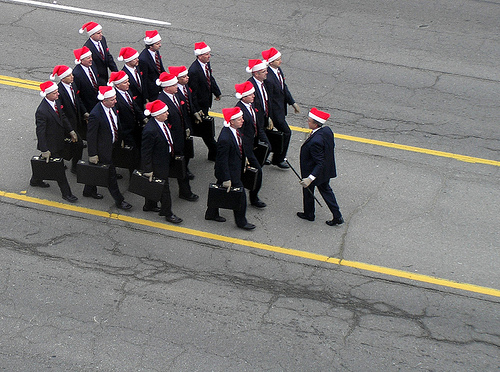
This picture from Flickr was taken at the Detroit thanksgiving day parade. Evidently they are a regular feature of the parade. Many thoughts went through my head when I saw it, as I bet it did with you too. First of course is the thought of marching off in step with the rest of the nine to fives to a job you dislike, unthinking consciously trying to get through another day. Sorry for making it sound so grim, I'm sure there are millions of people who like or love their jobs. I was just not one of them. In the forty-four years of my working life, I went to work each day because I had too. I never hated my work, its just that I always wished I had one of those jobs that people prepare for, yearn for, want more than any other job they could possibly have. One of those jobs that the prime concern is not the amount of money you receive, but just the job itself is important. I think of scientists, the mad scientist if you will, or perhaps an archiologist digging holes in some desert floor, jobs that look deadly boring, but demand all the the persons attention and intelligence.


The other thought that went through my head was harking back to my soldiering days when I had to keep in step with the guy next to me, and wondered how did I get here? I was never much of a soldier so the picture is perfect in symbolizing a civilian pretending to be a soldier, that was me.

November 30, 2006


A POSTCARD FROM MANSFIELD OHIO

My first postcard from Mansfield is about Christmas in a small town.

Right after Thanksgiving the town, as they have for as long as I can remember, decorates the downtown with wreaths hanging from the light poles, and strings lights. In the olden days, that’s when I was a kid, it was an annual event, piling the whole family in the car and going downtown after dark and exclaiming over the spectacle. Remember, this was before television, and radio was still king. We weren’t very world-wise, but we were wise to what was good, and this was good. Also in those days, before global warming, it seemed to always be snowing and that added to the sight.

The town has gone through its bad days as have thousands of medium to small towns across the country. At one time Mansfield was a booming industrial town that boasted many plants such as Westinghouse, Tappans, Empire Steel, Dominion electric, Mansfield Tire company, Ohio Brass, and so many more. When the Second World War came, they all converted to war needs. But as it always happens, it finally came to an end when the factories owners decided to look for cheaper labor and they usually headed south. The retail stores at about the same time headed out of the town into malls. Does this sound familiar? The classic ingredients of watching a town die. But I am happy to say after many, many years and many people willing to spend some of their money they have made much headway in clearing out old abandoned buildings or, and this is great, renovating them. Now chic bistros and specialty shops are inhabiting our downtown and it is looking good. It never will be as it was, but it doesn’t look like an abandoned disaster area. It’s a pleasant place to spend some time and hopefully some money.

But for we who were here in the heyday, the forties and fifties, we will always have our memories, as Rick related to Ilsa in Casablanca about Paris, and they are good.


November 29, 2006


I ran across this picture in Flickr. It's a clue to where I've been the last few days. I've been Christmas shopping and one of those places on my list was the book store a couple times. While there I enjoyed their latte, mocha, coffee drinks. Sitting in a bookstore and sipping away on one of these treats is one of my favorite relaxations.
SPEAKING OF WHICH: TODAY BACK IN HISTORY IN 1942 TO BE PRECISE, COFFEE BECAME RATIONED.
1942: US rations coffee

US grocery stores were able to sell coffee today after a week-long sales freeze; although, the drink was now rationed by the US government in order to ensure a fair distribution of the limited supply during World War II.

"Stamp No. 27 in the 'Sugar Book' (lower left-hand corner) is good for one pound of coffee through Sunday, January 3, 1943, if the age shown at time of registration was 15 years or over. Any person not having a 'Sugar Book' may still obtain one by registering (prior to December 15, 1942) with his local War Price and Ration Board, and subject to age limit, the stamps will be good for coffee, too," an ad in The Modesto Bee and News-Herald explained on November 30, 1942.

While each person 15 years or older was entitled to one pound of coffee every five weeks (which equals about one cup a day), Americans were encouraged not to use all of their family's coupons at once. "Just buy what you need – don't be a drip and dry up your neighbor's dripolator," the The Delta Democrat-Times read on November 29, 1942.

November 24, 2006


This painting by Manet has always puzzled me. It seems so out of synch with its century. It looks like it should be found in a girly mag of our day. No one I've read has ever really understood what was, or was not, going on. The following are the facts ma'am as Joe Friday used to say written by Thomas Hoving who knows as much about it as anybody.


In the Salon des Refuses exhibition, one painting in many ways marked
the beginning of the Impressionist style and was the banner of the new independent spirit: Manet's Dejeuner sur l'Herbe (1863), which depicts two fully clothed, elegant males lolling in a sun-dappled wood with one naked lady and one scantily clad lady. You probably aren't astonished that the crit­ics of the time found the subject bizarre and unseemly, but you will be puzzled to know that what struck the critics as even more hideous - some­thing even approaching moral degradation - were the fragmented colors Manet used to simulate flickering sunlight and his technique of laying paint in broad swaths.

November 22, 2006


Augustus and Winston
Conversations:
WAR


Gus’s caretaker had propped pillows up against the headboard, allowing him to sit up,
and it felt wonderful. Pictures were strewn all about him, as his parents, his children and his wife looked back at him courtesy of Mr. Eastman’s magic lantern.

All you had to do was look at the hues of the prints to determine the age of the subjects.
Dad and Mom were standing erect with not a hint of a smile. Getting your picture taken
in those days seemed to be a serious business. His children grew older and younger as
the photographs lay in no chronological order, and the memories came back in no order
accordingly. He had been blessed with good children, but it seemed by looking at the
pictures that he might have favored one over the other if you counted each image. But
in the march of changing technology, one was recorded by the still camera, another by
silent movies, and another by photographic slides, so on some future day, probably soon,
when they would sort through their father’s picture box, they might attach the amount of pictures, many or few, to favoritism, although that certainly was never the case. But that will be up to the individuals mindset, as it always is, and factored in with hundreds of other pieces of
the life they knew, until the final piece is assembled, and ‘the father’ they are comfortable
with and will remember for the rest of their lives appears.

A sudden sadness came over Gus as he pulled an often-handled photo out from under the pile.
A picture of a young, lean man with chiseled cheekbones and ash colored hair, named Hank
Potter from Norman, Oklahoma looked back at him. He, like hundreds of other men from
Oklahoma in those days, was nicknamed Okie. He stood posing in front of a tent, offering
him a taste of something from a tin can with the lid still attached and pulled back. He was
rubbing his stomach, in pantomime confirming the deliciousness of the rations; a cigarette
rested on his ear, a treat to be savored later after he had finished off the wonderful meal he
was pleased to share with him.

It was a happy day for all of us. We had survived the war and were preparing for shipment
home, except for Okie. He had decided that he really didn’t have much to go home to, and
he had found a home in the Army, as they liked to say. He was going to re-enlist. It was
the last picture taken of Okie before we shipped out.

It was the only picture he still had of Okie. They had written a couple letters back and forth,
but that soon petered out, as Okie got busy when Korea heated up and he went back to the
business of soldiering big time. The last letter he received was from a soldier he didn’t know
who explained that one of Hank’s wishes was that he be notified if anything happened to him.
He was killed when the North Koreans, aided by the Chinese, counter-attacked and pushed
the Americans into a full-scale retreat. The soldier said that Hank was one of the first killed,
so he didn’t live to be part of the retreat. He thought that might be a comfort to Gus. It hit him
hard and the pain never really went away, it just went down a level to a tolerable degree and
stayed there with the memories of his wife.

War is such a waste, he thought once again, and now he would have to worry about his grandson, who only this past week had gotten orders to prepare for deployment. He wassitting surrounded by his pictures, eyes closed, with his head lying back on his pillows when a now familiar voice interrupted his thoughts.

“Are we having a bad day Gus? Or are you trying to get a little shut-eye?” came the reedy voice
of Winston Cartier, his now daily visitor. Winston, a mouse of heroic intelligence, and little patience with self-pity, stood at his accustomed spot on the bedside table, standing atop whatever Gus was currently reading. His outfit of the day indicated that he must have been reading Gus’s thoughts. He was dressed all in khaki; shirt, trousers and necktie.

Gus, pleased to see his visitor, answered. “Neither; in the way you mean my friend, I’ve been
reminiscing about my war and worrying about my grandson’s war, and thinking that war has got
to be the most inane way to settle things ever devised by man. And it was man who devised it,
not God, because he wouldn’t have anything to do with it, of that I’m positive. You know, I find
it obscene that when we’re at war, both sides of the conflict invariably try to co-op God to their
side. Damn, that galls me. If we must fight these wars every ten years or so somewhere on the
planet, the blame should be on the combatants and not God, nor should we, or they, solicit his
blessings and put him at the head of the marching column and pretend that ‘our war’, ‘our side’,
is the side sanctioned and condoned by him. Nothing is farther from the truth and you know it.
If we must fight, and it seems we must, and right has to be on our side, then the people should be the ones that sanction our role in it. Leave God out of it, he will be busy enough gathering up the souls of those killed in the stinking conflicts that follow.”

“You’re really wound up in this aren’t you my friend”, said Winston, sitting down now since his
friend Gus seemed quite eager and ready to continue. “Are you saying what I think you’re saying, that God has no responsibility for what is going to happen?”

“No, I’m not saying that at all. What I am saying is this. War’s are made by man, and will be fought by man. But each side invariably wants to put God in a flak jacket and a helmet, marching at the head of the column with a weapon slung over his shoulder, because our cause is divinely right. No, No, No. I think God looks at us killing each other and is properly disgusted with all of us.”

“Then,” Winston broke in, “you don’t believe in the Just War Theory?”

“I’m not sure I know what that is.”

“Well as you know, war’s have been going on forever. Even the bible hints at ongoing discussions about ethical behavior during wars. Saint Thomas Aquinas wrote at length about justifications of war, and kinds of activity that are permissible. Moral considerations involving woman and children and treatment of prisoners are deemed honorable and should be adhered to, or dishonor will befall those who don’t adhere to the code. Indeed the Just War Theory believes that wars can be just, if they are fought ethically, and morally.”

Gus sat back and closed his eyes. “I’ve been in war, and I’ve thought a lot about war, but I don’t think I have ever thought about war being a moral undertaking. At least to the one’s who have to do the killing. I think it boils down to a kill or be killed proposition. Even in the Second World War, which was most likely America’s ‘Just War’, or as Studs Terkel titled his book, The Good War, when you boil it down to it’s essentials, it’s a killing game and I bet the parents of a fallen combatant on either side believe their son has fought and died for the right reasons, and for the right side. They have to, or they would never be able to go on with life. I think the term, a Just War, and The Good War is nothing but an oxymoron. Wars are dirty and immoral consequences of intelligent people not being able to find a better solution. In these days of instant world-wide communications between world leaders it is inconceivable to me that reasonable men
cannot find men of like mind and bypass the barbaric acts of war.”

Gus lay back on his pillow, out of breath, and out of words to express his sadness and frustrations over yet another armed conflict in the offing, and this one would include his grandchild.

Winston was, at this point, more than a little concerned that his friend Gus may have squandered too much of his diminishing supply of energy on a subject that is at best perplexing and most probably unsolvable. Although he understood that once a person is personally involved in war, it remains a hot subject never to be forgotten or softened by the passage of time. As far as the abolishment of all war, it seemed an impossible idea at best. War is a lucrative undertaking and will boost the economies on any country taking part, as long as you win of course, and America being the only superpower on the map these days, the economic gains are motivation to move the country in that direction if at all possible.

But to bring this, or any other theory up to Augustus at this time would upset him and maybe push him over the edge into the only place that will assure him of peace eternal. Winston was not ready to lose his new friend just yet, so this and other thoughts on why war is not repugnant to any civilized person would have to wait until he recovered some strength, if he could.

November 21, 2006


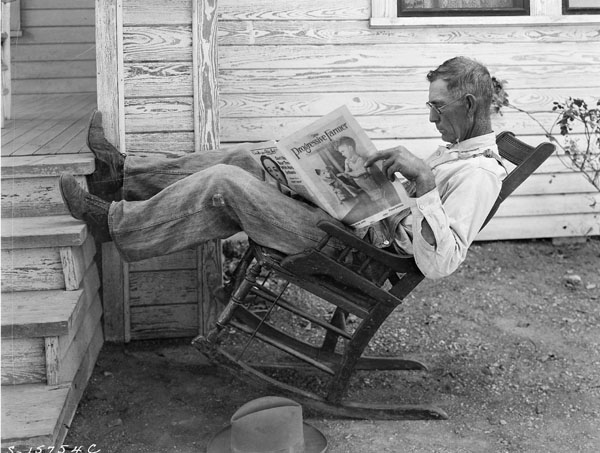
Rockin’ Chair
Written by: Hoagy Carmichael

Ol’ rockin’ chair’s got me

Cane by my side

Fetch me that ginseng

‘Fore I tan your hide

Can’t get from this cabin

Ain’t goin’ nowhere

Just sittin’ me here grabbin’At the flies

‘round thisOl’ rockin’ chair

My dear old aunt Harriet

In heaven she be

Send me sweet chariot

For the end of these troubles I see

Ol’ rockin’ chair gets it

Judgement day is here

I’m chained to my oldRockin’ chair

(picture was taken in 1931 in Texas.)

November 20, 2006

This little clip from Charlie Chaplins MODERN TIMES, is funny, but if you've ever worked on an assembly line, it might not be. Its de-humanizing in a way having a man or woman stand in one place for a whole shift of eight hours doing nothing more than adding a part or screwing in the screws, doing one very small part repetitiously. I did once for three months and I don't recommend it. If you are a thinking person, and how could you not be, standing in one place for eight hours doing one task over, and over, and over, you have to wonder, Isn't there something more fulfilling I can dedicate my life to?

http://www.youtube.com/watch?v=IjarLbD9r30

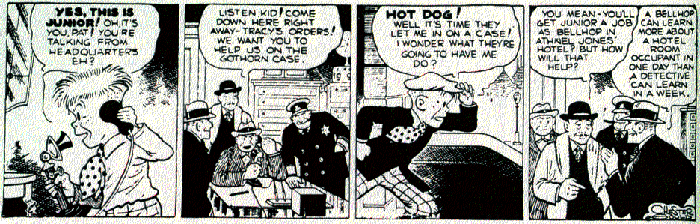
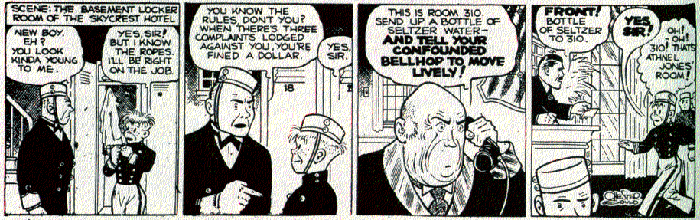
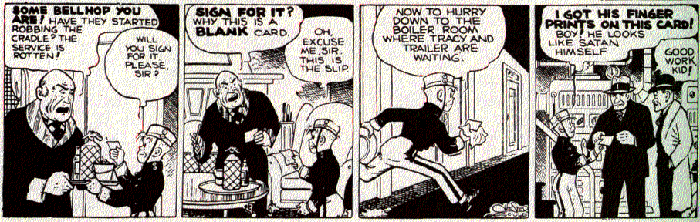
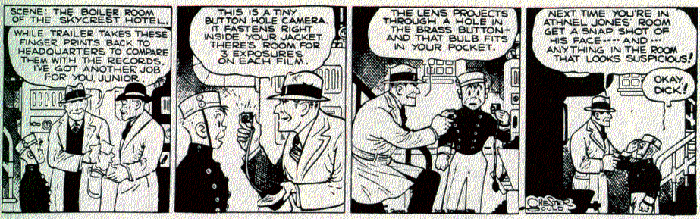
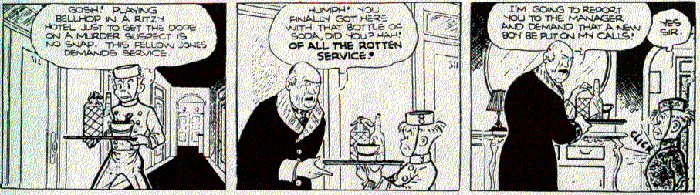
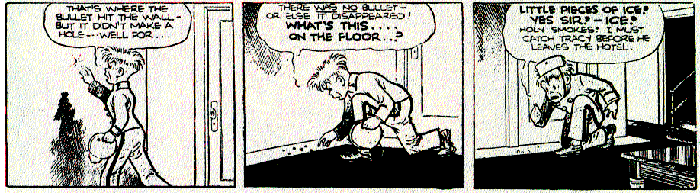
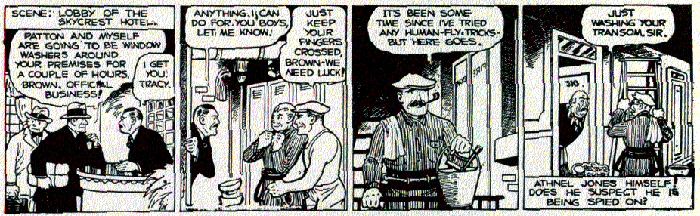
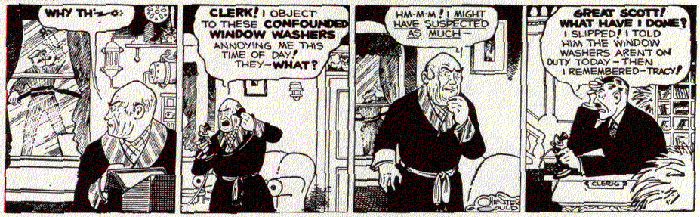
Chester Gould's DICK TRACY
A selection from the 1936 seeries: THE HOTEL MURDERS

When Addie Gothorn, a notorious gambler, is found dead in a hotel, Dick Tracy cancels his planned vacation to investigate the crime. All clues point to Athnel Jones, who is living in Skycrest Aparatments. The only problem? No bullet. Someone is on a shooting spree with a gun that leaves no bullets in the bodies of its victims. The only way to solve this crime is for Tracy to call in his top investigator-Junior.


Once captured, Athnel Jones makes a full confession. Tracy discovers a box containing two pistols that shoot paraffine-coated bullets of ice. The ice would melt away and leave no ballistic evidence. The murder weapon is discovered and another crime is solved.

November 18, 2006

Diet Snapple fact #140 says: Holland is the only country with a national dog.

I know you want to know the answer, so here it is:

Holland's national dog is the Keeshond, also known as Wolfsspitz (inGermany), Chien Loup (in France), or Lupini (in Italy). Originally,the Keeshond was a watchdog on Dutch canal barges, riverboats, and farms, and it is still often used for this purpose today.


Remember the secret decoder ring and other premiums we could send in for from Dick Tracy on the radio? Here is a premium from Dick Tracy, click and listen.http://www.old-time.com/premiums/dick_tracy_380209.ram It may take a minute for the audio to start but hang in there.

November 16, 2006


FORGOTTEN

By Jim Kittelberger


The bicycle leans against the back of the garage
Forgotten, as the boy turning young man tinkers
On his old jalopy
Forgotten in the rush of time
Becoming part of the past just as the freckles
Fade from the boys’ face, so too am I
Relegated to moments past, joys of another day.

So shall It remain here out of sight, in darkness
And light, in rain and snow
Until one day to be rediscovered
Standing just where It was placed and forgotten
Except by time and rust
To be manhandled and thrown in the trashmans
Truck and taken to a place out of sight of todays
Hustle and bustle and thrown amongst yesterdays
Memories.

November 15, 2006

'Buffalo Bob Smith' talks about how it was all done on the Howdy Doody show. An early television show for kids utilizing puppets and Bob in humorous activities. At least we thought so back in those days. If you are old enough to have been around in those early days of tv or not, you might enjoy some inside television. http://video.google.com/videoplay?docid=-7742267713290172747&q=%22public+domain%22+duration%3Along

November 14, 2006


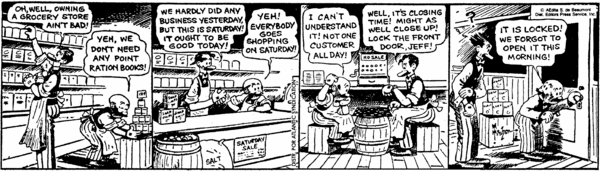
I absolutely love the Internet, and I’m nearing seventy. There is truly something for everyone. I relish books that are set in the forties, listening to old time radio, even reading the old comics from the newspapers. My goodness, you can immerse yourself in subjects and objects that were new when you were. You can read the comics daily just as you did back then. Here is one I look at everyday. It’s Mutt and Jeff, but this particular strip reminds me an awfully lot of Lum and Abner and their Jot-It-Down store. It will probably not appeal to the now generation who will probably dismiss them as ‘hillbillies’ or backward, or really corny, (does anybody use that word anymore?) but back in the time I immerse myself in occasionally, we were not very sophisticated until much later in life. Actually I never did make it to sophisticated, oh well.