November 30, 2006


A POSTCARD FROM MANSFIELD OHIO

My first postcard from Mansfield is about Christmas in a small town.

Right after Thanksgiving the town, as they have for as long as I can remember, decorates the downtown with wreaths hanging from the light poles, and strings lights. In the olden days, that’s when I was a kid, it was an annual event, piling the whole family in the car and going downtown after dark and exclaiming over the spectacle. Remember, this was before television, and radio was still king. We weren’t very world-wise, but we were wise to what was good, and this was good. Also in those days, before global warming, it seemed to always be snowing and that added to the sight.

The town has gone through its bad days as have thousands of medium to small towns across the country. At one time Mansfield was a booming industrial town that boasted many plants such as Westinghouse, Tappans, Empire Steel, Dominion electric, Mansfield Tire company, Ohio Brass, and so many more. When the Second World War came, they all converted to war needs. But as it always happens, it finally came to an end when the factories owners decided to look for cheaper labor and they usually headed south. The retail stores at about the same time headed out of the town into malls. Does this sound familiar? The classic ingredients of watching a town die. But I am happy to say after many, many years and many people willing to spend some of their money they have made much headway in clearing out old abandoned buildings or, and this is great, renovating them. Now chic bistros and specialty shops are inhabiting our downtown and it is looking good. It never will be as it was, but it doesn’t look like an abandoned disaster area. It’s a pleasant place to spend some time and hopefully some money.

But for we who were here in the heyday, the forties and fifties, we will always have our memories, as Rick related to Ilsa in Casablanca about Paris, and they are good.


November 29, 2006


I ran across this picture in Flickr. It's a clue to where I've been the last few days. I've been Christmas shopping and one of those places on my list was the book store a couple times. While there I enjoyed their latte, mocha, coffee drinks. Sitting in a bookstore and sipping away on one of these treats is one of my favorite relaxations.
SPEAKING OF WHICH: TODAY BACK IN HISTORY IN 1942 TO BE PRECISE, COFFEE BECAME RATIONED.
1942: US rations coffee

US grocery stores were able to sell coffee today after a week-long sales freeze; although, the drink was now rationed by the US government in order to ensure a fair distribution of the limited supply during World War II.

"Stamp No. 27 in the 'Sugar Book' (lower left-hand corner) is good for one pound of coffee through Sunday, January 3, 1943, if the age shown at time of registration was 15 years or over. Any person not having a 'Sugar Book' may still obtain one by registering (prior to December 15, 1942) with his local War Price and Ration Board, and subject to age limit, the stamps will be good for coffee, too," an ad in The Modesto Bee and News-Herald explained on November 30, 1942.

While each person 15 years or older was entitled to one pound of coffee every five weeks (which equals about one cup a day), Americans were encouraged not to use all of their family's coupons at once. "Just buy what you need – don't be a drip and dry up your neighbor's dripolator," the The Delta Democrat-Times read on November 29, 1942.

November 24, 2006


This painting by Manet has always puzzled me. It seems so out of synch with its century. It looks like it should be found in a girly mag of our day. No one I've read has ever really understood what was, or was not, going on. The following are the facts ma'am as Joe Friday used to say written by Thomas Hoving who knows as much about it as anybody.


In the Salon des Refuses exhibition, one painting in many ways marked
the beginning of the Impressionist style and was the banner of the new independent spirit: Manet's Dejeuner sur l'Herbe (1863), which depicts two fully clothed, elegant males lolling in a sun-dappled wood with one naked lady and one scantily clad lady. You probably aren't astonished that the crit­ics of the time found the subject bizarre and unseemly, but you will be puzzled to know that what struck the critics as even more hideous - some­thing even approaching moral degradation - were the fragmented colors Manet used to simulate flickering sunlight and his technique of laying paint in broad swaths.

November 22, 2006


Augustus and Winston
Conversations:
WAR


Gus’s caretaker had propped pillows up against the headboard, allowing him to sit up,
and it felt wonderful. Pictures were strewn all about him, as his parents, his children and his wife looked back at him courtesy of Mr. Eastman’s magic lantern.

All you had to do was look at the hues of the prints to determine the age of the subjects.
Dad and Mom were standing erect with not a hint of a smile. Getting your picture taken
in those days seemed to be a serious business. His children grew older and younger as
the photographs lay in no chronological order, and the memories came back in no order
accordingly. He had been blessed with good children, but it seemed by looking at the
pictures that he might have favored one over the other if you counted each image. But
in the march of changing technology, one was recorded by the still camera, another by
silent movies, and another by photographic slides, so on some future day, probably soon,
when they would sort through their father’s picture box, they might attach the amount of pictures, many or few, to favoritism, although that certainly was never the case. But that will be up to the individuals mindset, as it always is, and factored in with hundreds of other pieces of
the life they knew, until the final piece is assembled, and ‘the father’ they are comfortable
with and will remember for the rest of their lives appears.

A sudden sadness came over Gus as he pulled an often-handled photo out from under the pile.
A picture of a young, lean man with chiseled cheekbones and ash colored hair, named Hank
Potter from Norman, Oklahoma looked back at him. He, like hundreds of other men from
Oklahoma in those days, was nicknamed Okie. He stood posing in front of a tent, offering
him a taste of something from a tin can with the lid still attached and pulled back. He was
rubbing his stomach, in pantomime confirming the deliciousness of the rations; a cigarette
rested on his ear, a treat to be savored later after he had finished off the wonderful meal he
was pleased to share with him.

It was a happy day for all of us. We had survived the war and were preparing for shipment
home, except for Okie. He had decided that he really didn’t have much to go home to, and
he had found a home in the Army, as they liked to say. He was going to re-enlist. It was
the last picture taken of Okie before we shipped out.

It was the only picture he still had of Okie. They had written a couple letters back and forth,
but that soon petered out, as Okie got busy when Korea heated up and he went back to the
business of soldiering big time. The last letter he received was from a soldier he didn’t know
who explained that one of Hank’s wishes was that he be notified if anything happened to him.
He was killed when the North Koreans, aided by the Chinese, counter-attacked and pushed
the Americans into a full-scale retreat. The soldier said that Hank was one of the first killed,
so he didn’t live to be part of the retreat. He thought that might be a comfort to Gus. It hit him
hard and the pain never really went away, it just went down a level to a tolerable degree and
stayed there with the memories of his wife.

War is such a waste, he thought once again, and now he would have to worry about his grandson, who only this past week had gotten orders to prepare for deployment. He wassitting surrounded by his pictures, eyes closed, with his head lying back on his pillows when a now familiar voice interrupted his thoughts.

“Are we having a bad day Gus? Or are you trying to get a little shut-eye?” came the reedy voice
of Winston Cartier, his now daily visitor. Winston, a mouse of heroic intelligence, and little patience with self-pity, stood at his accustomed spot on the bedside table, standing atop whatever Gus was currently reading. His outfit of the day indicated that he must have been reading Gus’s thoughts. He was dressed all in khaki; shirt, trousers and necktie.

Gus, pleased to see his visitor, answered. “Neither; in the way you mean my friend, I’ve been
reminiscing about my war and worrying about my grandson’s war, and thinking that war has got
to be the most inane way to settle things ever devised by man. And it was man who devised it,
not God, because he wouldn’t have anything to do with it, of that I’m positive. You know, I find
it obscene that when we’re at war, both sides of the conflict invariably try to co-op God to their
side. Damn, that galls me. If we must fight these wars every ten years or so somewhere on the
planet, the blame should be on the combatants and not God, nor should we, or they, solicit his
blessings and put him at the head of the marching column and pretend that ‘our war’, ‘our side’,
is the side sanctioned and condoned by him. Nothing is farther from the truth and you know it.
If we must fight, and it seems we must, and right has to be on our side, then the people should be the ones that sanction our role in it. Leave God out of it, he will be busy enough gathering up the souls of those killed in the stinking conflicts that follow.”

“You’re really wound up in this aren’t you my friend”, said Winston, sitting down now since his
friend Gus seemed quite eager and ready to continue. “Are you saying what I think you’re saying, that God has no responsibility for what is going to happen?”

“No, I’m not saying that at all. What I am saying is this. War’s are made by man, and will be fought by man. But each side invariably wants to put God in a flak jacket and a helmet, marching at the head of the column with a weapon slung over his shoulder, because our cause is divinely right. No, No, No. I think God looks at us killing each other and is properly disgusted with all of us.”

“Then,” Winston broke in, “you don’t believe in the Just War Theory?”

“I’m not sure I know what that is.”

“Well as you know, war’s have been going on forever. Even the bible hints at ongoing discussions about ethical behavior during wars. Saint Thomas Aquinas wrote at length about justifications of war, and kinds of activity that are permissible. Moral considerations involving woman and children and treatment of prisoners are deemed honorable and should be adhered to, or dishonor will befall those who don’t adhere to the code. Indeed the Just War Theory believes that wars can be just, if they are fought ethically, and morally.”

Gus sat back and closed his eyes. “I’ve been in war, and I’ve thought a lot about war, but I don’t think I have ever thought about war being a moral undertaking. At least to the one’s who have to do the killing. I think it boils down to a kill or be killed proposition. Even in the Second World War, which was most likely America’s ‘Just War’, or as Studs Terkel titled his book, The Good War, when you boil it down to it’s essentials, it’s a killing game and I bet the parents of a fallen combatant on either side believe their son has fought and died for the right reasons, and for the right side. They have to, or they would never be able to go on with life. I think the term, a Just War, and The Good War is nothing but an oxymoron. Wars are dirty and immoral consequences of intelligent people not being able to find a better solution. In these days of instant world-wide communications between world leaders it is inconceivable to me that reasonable men
cannot find men of like mind and bypass the barbaric acts of war.”

Gus lay back on his pillow, out of breath, and out of words to express his sadness and frustrations over yet another armed conflict in the offing, and this one would include his grandchild.

Winston was, at this point, more than a little concerned that his friend Gus may have squandered too much of his diminishing supply of energy on a subject that is at best perplexing and most probably unsolvable. Although he understood that once a person is personally involved in war, it remains a hot subject never to be forgotten or softened by the passage of time. As far as the abolishment of all war, it seemed an impossible idea at best. War is a lucrative undertaking and will boost the economies on any country taking part, as long as you win of course, and America being the only superpower on the map these days, the economic gains are motivation to move the country in that direction if at all possible.

But to bring this, or any other theory up to Augustus at this time would upset him and maybe push him over the edge into the only place that will assure him of peace eternal. Winston was not ready to lose his new friend just yet, so this and other thoughts on why war is not repugnant to any civilized person would have to wait until he recovered some strength, if he could.

November 21, 2006


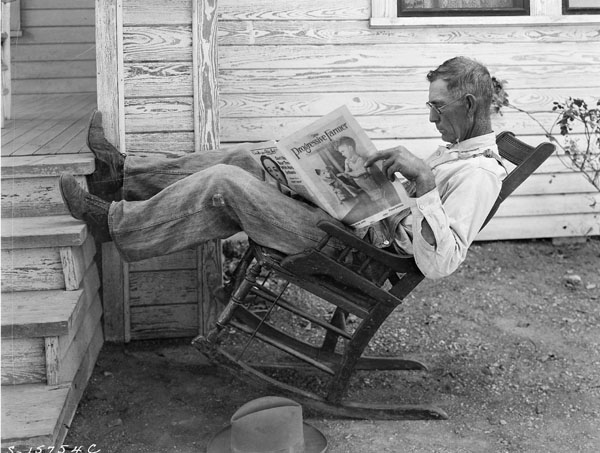
Rockin’ Chair
Written by: Hoagy Carmichael

Ol’ rockin’ chair’s got me

Cane by my side

Fetch me that ginseng

‘Fore I tan your hide

Can’t get from this cabin

Ain’t goin’ nowhere

Just sittin’ me here grabbin’At the flies

‘round thisOl’ rockin’ chair

My dear old aunt Harriet

In heaven she be

Send me sweet chariot

For the end of these troubles I see

Ol’ rockin’ chair gets it

Judgement day is here

I’m chained to my oldRockin’ chair

(picture was taken in 1931 in Texas.)

November 20, 2006

This little clip from Charlie Chaplins MODERN TIMES, is funny, but if you've ever worked on an assembly line, it might not be. Its de-humanizing in a way having a man or woman stand in one place for a whole shift of eight hours doing nothing more than adding a part or screwing in the screws, doing one very small part repetitiously. I did once for three months and I don't recommend it. If you are a thinking person, and how could you not be, standing in one place for eight hours doing one task over, and over, and over, you have to wonder, Isn't there something more fulfilling I can dedicate my life to?

http://www.youtube.com/watch?v=IjarLbD9r30

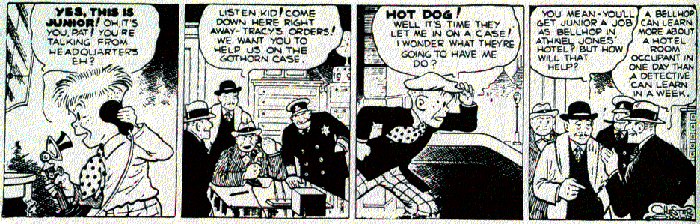
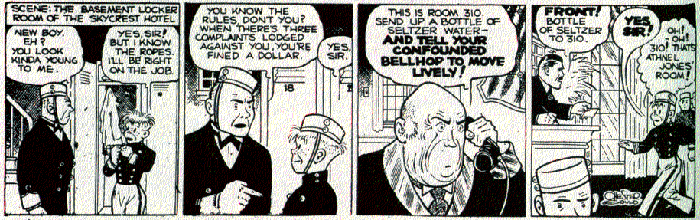
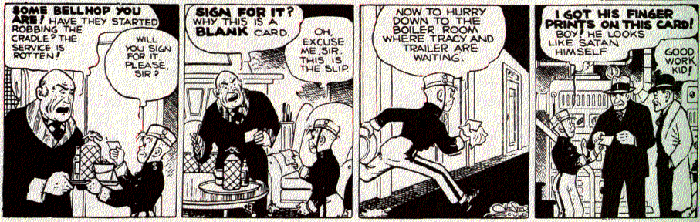
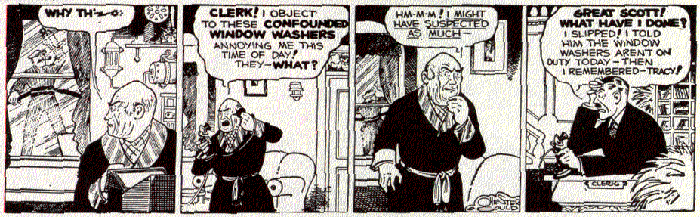
Chester Gould's DICK TRACY
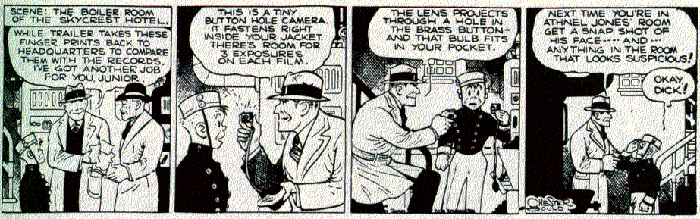
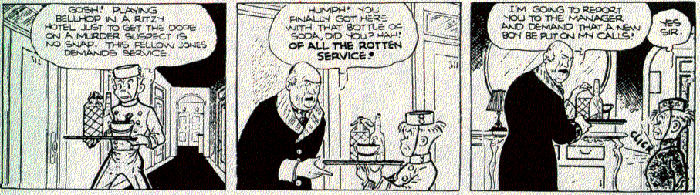
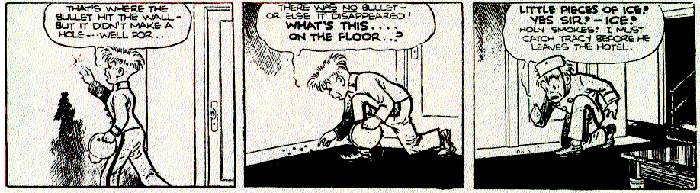
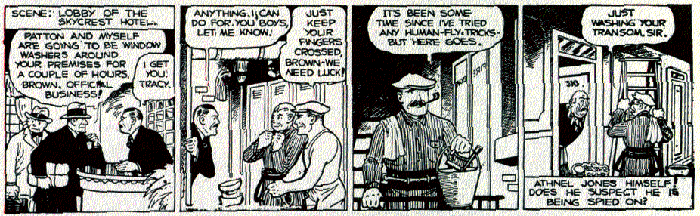
A selection from the 1936 seeries: THE HOTEL MURDERS

When Addie Gothorn, a notorious gambler, is found dead in a hotel, Dick Tracy cancels his planned vacation to investigate the crime. All clues point to Athnel Jones, who is living in Skycrest Aparatments. The only problem? No bullet. Someone is on a shooting spree with a gun that leaves no bullets in the bodies of its victims. The only way to solve this crime is for Tracy to call in his top investigator-Junior.


Once captured, Athnel Jones makes a full confession. Tracy discovers a box containing two pistols that shoot paraffine-coated bullets of ice. The ice would melt away and leave no ballistic evidence. The murder weapon is discovered and another crime is solved.

November 18, 2006

Diet Snapple fact #140 says: Holland is the only country with a national dog.

I know you want to know the answer, so here it is:

Holland's national dog is the Keeshond, also known as Wolfsspitz (inGermany), Chien Loup (in France), or Lupini (in Italy). Originally,the Keeshond was a watchdog on Dutch canal barges, riverboats, and farms, and it is still often used for this purpose today.


Remember the secret decoder ring and other premiums we could send in for from Dick Tracy on the radio? Here is a premium from Dick Tracy, click and listen.http://www.old-time.com/premiums/dick_tracy_380209.ram It may take a minute for the audio to start but hang in there.

November 16, 2006


FORGOTTEN

By Jim Kittelberger


The bicycle leans against the back of the garage
Forgotten, as the boy turning young man tinkers
On his old jalopy
Forgotten in the rush of time
Becoming part of the past just as the freckles
Fade from the boys’ face, so too am I
Relegated to moments past, joys of another day.

So shall It remain here out of sight, in darkness
And light, in rain and snow
Until one day to be rediscovered
Standing just where It was placed and forgotten
Except by time and rust
To be manhandled and thrown in the trashmans
Truck and taken to a place out of sight of todays
Hustle and bustle and thrown amongst yesterdays
Memories.

November 15, 2006

'Buffalo Bob Smith' talks about how it was all done on the Howdy Doody show. An early television show for kids utilizing puppets and Bob in humorous activities. At least we thought so back in those days. If you are old enough to have been around in those early days of tv or not, you might enjoy some inside television. http://video.google.com/videoplay?docid=-7742267713290172747&q=%22public+domain%22+duration%3Along

November 14, 2006


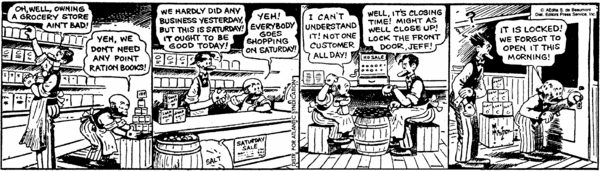
I absolutely love the Internet, and I’m nearing seventy. There is truly something for everyone. I relish books that are set in the forties, listening to old time radio, even reading the old comics from the newspapers. My goodness, you can immerse yourself in subjects and objects that were new when you were. You can read the comics daily just as you did back then. Here is one I look at everyday. It’s Mutt and Jeff, but this particular strip reminds me an awfully lot of Lum and Abner and their Jot-It-Down store. It will probably not appeal to the now generation who will probably dismiss them as ‘hillbillies’ or backward, or really corny, (does anybody use that word anymore?) but back in the time I immerse myself in occasionally, we were not very sophisticated until much later in life. Actually I never did make it to sophisticated, oh well.
Diet Snapple Real Fact #72 says: The average person uses 150 gallons of water a day for personal use.

The title of this picture is STEAM PUMP taken by Lewis Hine in 1920. The human subject is a powerhouse mechanic and I think the picture works so well because it depicts power deriving from the machine and the man.


On a personal level I like the picture because it reminds me of my late father-in-law, whom I admired and who was also a powerhouse mechanic who toiled in the powerhouses of General Motors.

November 11, 2006


You are looking into an A&P window in the year 1936. Before you get too nostalgic about those prices, you should know the average income was $26.00 per week.

November 10, 2006


Found. While rooting around in the attic, I came across a small stack of old 45 rpm records. Among them was this recording of Bill Haley's Rock Around The Clock. Needless to say, it peeled away fifty years off this old body. Another in the stack was the song, Gonna Get Along Without Ya Now, by Patience and Prudence, a song that really takes me back. When I was courting my wife in the early fifties of the last century, my girl friend (wife-to-be) and her sister would sing this song while doing dishes after supper. They really did a great job, maybe I'm a little prejudiced, but they really did. Ahh wonderful memories, and where did the time go?

November 9, 2006

The second of three completed installments of Augustus and Winston conversations. This one is called THE MIND. A whimsical meeting of a dying man and a beast (well a mouse) who cuts him no slack.


AUGUSTUS AND WINSTON
CONVERSATIONS:
THE MIND

By Jim Kittelberger


His eyes, wide open, stared at the ceiling at that gray on gray time of the night. That time when your mind sees everything crystal clear without the coloration of sun and shadows; When everything is so clear and dimensional, without hopes or wishes to cling to; when the truth is so omnipresent it is accompanied by an almost physical pain, and there is absolutely no place to hide, no appeals to make, no excuses, no chance of a mistake. It’s the time when truth, your truth, crashes into you head on.

It was that moment for Gus. He knew his moment of truth was arriving, when the future, his future, was written in the shadows of the ceiling. He knew for a certainty that he would never again leave this bed. He knew that he would never again feel that built up physical energy, pent up after a good nights sleep and hardly able to contain itself one minute longer, straining to burst free and run. Just run, full out, with the wind in his face, running just for the hell of it because it felt so good, no reason for it except the feeling of legs raising and lowering like pistons, well-oiled and functioning as God planned for them to work. Sweat breaking out on his forehead, falling as gravity says it must, into his eyes and stinging; then falling, with no thought of pain, injury, or reason, onto the clean smelling grass and rolling until he lay on his back, arms and legs spread wide, looking up into the sun, smiling to himself, just because it seems like such a natural thing to do.

Gus lies there in his bed, smiling the smile he remembered from so long ago, when a familiar voice breaks into his reverie.

“That smile you have on your face tells me you must be revisiting the good times you had in your youth, in that bordello across the border”, came the irreverent voice of his companion these days, Winston Cartier.

“You know”, retorted Gus, “It just occurred to me that your initials are WC, I think it might stand for Water Closet, that place where your mouse mind resides.”

“That’s pretty good for an old coot like you,” responded Winston, “it shows you still have a little life left in you,” he said, showing Gus little or no sympathy for his present physical condition, or his status as a human.

“It’s good to see you again, you little badgering know-it-all, even with that toilet mouth of yours. Even though you’re dead wrong about where my mind was residing at the moment of your arrival.”

“Well, my frail friend, your mind is, well, your mind. It’s yours to use for good or ill. A quite powerful instrument for a piece of matter that only weighs three pounds, that is for you humans. For us in the mouse kingdom, it is of course less in direct relation to our size. Of course, in my case, if you believe in heredity, my offspring, if I choose to have any, should have a larger allocation of brain space. It is well known…..”

“Stop please,” interjected Gus. “I can’t take anymore. I am well aware of your mental powers, but please, I’m not a well man and I can take only so much baloney, from man or beast, er mouse.”

“As a matter of fact,” Gus continued, “The source of the smile you happened to glimpse, was from one of the powers of our brain, our memory. I happened to be recalling, quite vividly, I might add, a moment in life where nothing else mattered except the moment. When life is stretched out in front of us forever, and time is irrelevant. Death was a nebulous term with no meaning. Our grandparents were still with us and the only time that word death had any meaning was perhaps at the death of a pet goldfish or dog, sad, but forgotten with the acquiring of a substitute. Perhaps, as I think of it now, it teaches a bad lesson, or no lesson at all, that death is not a permanent thing, and when it happens, we just acquire a different colored fish, or a dog with more hair. We learn nothing from the experience, and it teaches us that life, human or animal, is cheap and easily replaced.

“Maybe you didn’t learn anything Gus,” Winston replied, “but that’s just your experience. The mind doesn’t control us and tell us what to think or how to process information it receives. With it’s ten billion nerve cells it does a very good job of processing, but you have to interpret what information you get, but this is all getting too involved, and young humans are not yet old enough to make proper decisions with the information they receive, but I can assure you the experience is catalogued away and will be remembered forever and used as a database for making proper decisions at a later time in their lives. You higher class of vertebrates sometimes are a little dense, but eventually, if given enough time, will get it.”

“You don’t have to tell me the power of the mind, you wisenheimer rodent, I remember a time in my life when I was angry most of the time, angry because of my dissatisfaction with a situation that I could do nothing about, but I wore my bad attitude like a ill-fitting suit. That is until one day, while talking to my wife about my troubles, it came upon me like an epiphany that no one cared about my problems, except me and of course my poor wife who had to listen to the constant whining. It was like I discovered America and it was so simple. It was all in my mind. So many learned people had written books on the subject of positive thinking, but I was blind to them, until I changed my thinking and overnight, really, overnight my life changed.” Gus shook his head, “It was all so simple and I was too dumb to know it.”

“Life is a learning experience until we die,” said Winston, “I’m sure you’re still learning as you lie in what will surely be your death bed. Some sage says what you have accumulated through all your years is wisdom. Not just facts, but the experience to know what works and when to use it.” Winston actually smiled wistfully at the old man, then asked, “Tell me Gus, if you had the opportunity to live your life over, would you do anything differently? Now I’m not the genie with three wishes, not even one, so your answer is just rhetorical, I sadly cannot offer you new life.” Winston actually seemed moved just a little by asking the old man to rethink his entire life and encapsulate a gem for posterity, the answer for a happy life.

Gus laid his head back down on his pillow and thought for a moment. “Gladly, I can say I would not change much, except one thing. One thing sounds like I would wish for one more Hershey bar and that would close out a happy life, but the one thing I wish I would have done that I did not do, was to exercise the brain God gave me, by going on further in my schooling. I don’t have any way of knowing what would come from taking that path, but I feel it may have been like dropping a stone in the water and concentric circles appear over and over, expanding out to the shore. The waste, if that’s what it was, was my own doing, so I only have myself to blame for not knowing what might have been.”

Gus finished and looked over at his inquisitor, agitator, debating partner, late night companion and friend, “Not too bad, don’t you think, that I hold no grudges, owe no man, and have had the love of a wonderful woman and only have one regret for a lifetime, and that is wasting only what was mine to begin with.”

Winston, tipped his hat, an affectation he acquired after watching Rex Harrison in My Fair Lady, and replied, “Don’t get yourself all pumped up you old coot, with that pretentious eulogy you just gave yourself. You were probably too darn lazy to use anymore of your brain than you did, so be grateful with what you accomplished using only half of the brain God gave you and go to sleep dreaming about whatever you were dreaming about before. I still think it was that bordello just over the border and Madam Rosa’s best girls you were smiling about.”

Gus laughed out loud and then slept.

November 8, 2006


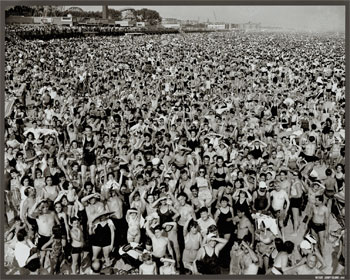
The war was nearly over when this picture was taken in 1945. Do you think that is the reason that all these people decided to go to the beach, to relax and celebrate? I don't think there is room for anyone to sit down. I look at this picture and wonder why when each person arrived, and saw all the people who had gotten there before them, they didn't turn around and go somewhere else. Human behavior is sometimes kind of weird, or maybe just New Yorkers, this picture was taken at Coney Island.

November 7, 2006

I have debuted a new site that I am still testing. It's called ON-HANDS STORYTIME. http://jim2jak.tripod.com/onhandsstorytime/

If anyone has a moment or two would you please go to the site and click on a couple of the sound bytes, and please let me know if it worked, or not. It works in testing, but you all know how that goes. What's that principal that says, if anything can go wrong, it will. I intend to add pictures to the site also, if it works.

Thank you all.

Hope you all voted today, and it turns out the way you want.

November 6, 2006


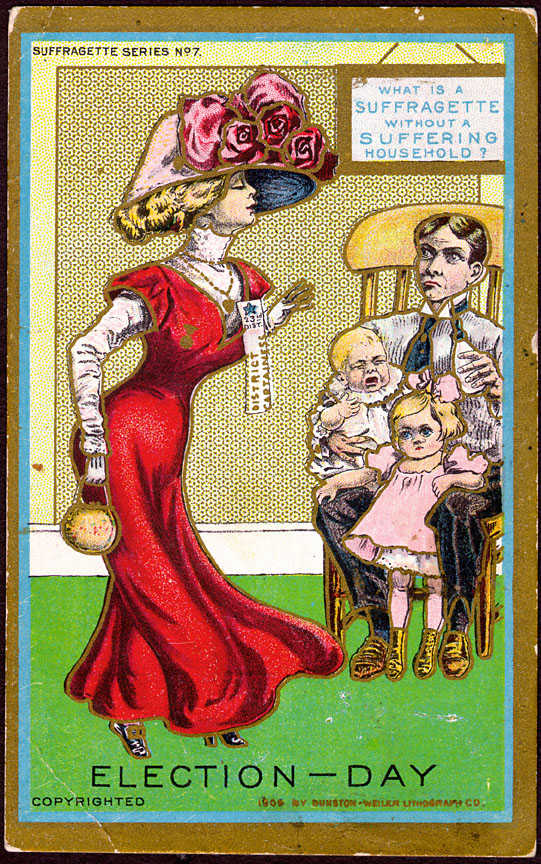
I think America is singing because we are free, and tomorrow we can vote to keep what we like and discard that which we don't. We're not perfect God knows, but we keep trying to be better. On Election day we can give it a little boost in whatever we think is the correct path to follow. Please exercise your right as Walt Whitman, the lady in the big hat, and I encourage you to do.


I Hear America Singing
from Leaves of Grass by Walt Whitman (1900)

I hear America singing, the varied carols I hear;
Those of mechanics—each one singing his, as it should be, blithe and strong;
The carpenter singing his, as he measures his plank or beam,
The mason singing his, as he makes ready for work, or leaves off work;
The boatman singing what belongs to him in his boat—the deckhand singing on the steamboat deck;
The shoemaker singing as he sits on his bench—
the hatter singing as he stands;
The wood-cutter’s song—the ploughboy’s, on his way in the morning, or at the noon intermission, or at sundown;
The delicious singing of the mother—or of the young wife at work—or of the girl sewing or washing—Each singing what belongs to her, and to none else;The day what belongs to the day—At night, the party of young fellows, robust, friendly,Singing, with open mouths, their strong melodious songs.

November 4, 2006


Before you jump in your car and head for this place, you will have to perfect time travel also. This was taken in 1936. That's even before I was born (one year before).

November 3, 2006

Diet peach Snapple Real Fact #112 says:

At birth, a Dalmation is always pure white.
I like to read as you probably do too, and I like to look at lists. I at first googled BEST BOOK EVER WRITTEN, but then I ran across this list using the same criteria. I figured who would know better about books than librarians, right? Right!

I quickly ran down the list and eliminating all the books I have either read, heard on tape, seen the movie, or just knew about generally, I still came up with seven (7) I had never heard of. Maybe I will check with my library and see if they have them.


THE 100 FAVORITE NOVELS OF LIBRARIANS
Based on a survey conducted by Brodart Co., September, 1998 - March, 1999

1. Pride and Prejudice
Austen
2. To Kill a Mockingbird
Lee
3. Jane Eyre
Bronte
4. Gone with the Wind
Mitchell
5. Lord of the Rings
Tolkien
6. The Catcher in the Rye
Salinger
7. Little Women
Alcott
8. A Prayer of Owen Meany
Irving
9. The Stand
King
10. The Great Gatsby
Fitzgerald
11. Mists of Avalon
Bradley
12. David Copperfield
Dickens
13. Kristen Lavransdotter x
Undset
14. Beloved
Morrison
15. Age of Innocence
Wharton
16. The Shell Seekers
Pilcher
17. Tess of the D'Urbervilles
Hardy
18. The World According to Garp
Irving
19. Catch 22
Heller
20. The Clan of the Cave Bear
Auel
21. The Horse Whisperer
Evans
22. Pillars of the Earth
Follett
23. Prince of Tides
Conroy
24. Possession
Byatt
25. Rebecca
DuMaurier
26. Follow the River
Thom
27. My Antonia
Cather
28. The Old Man and the Sea
Hemingway
29. The Scarlet Letter
Hawthorne
30. Sophies Choice
Styron
31. Snow Falling on Cedars
Guterson
32. One Hundred Years of Solitude
Marquez
33. Name of the Rose
Eco
34. The Giver x
Lowry
35. Cold Mountain
Frazier
36. Cold Sassy Tree
Burns
37. Atlas Shrugged
Rand
38. Bridge to Terebithia x
Paterson
39. Dinner at the Homesick Restaurant
Tyler
40. The Hobbit
Tolkien
41. Les Miserables
Hugo
42. The Lion, the Witch, and the Wardrobe
Lewis
43. Wuthering Heights
Bronte
44. A Tale of Two Cities
Dickens
45. Huckelberry Finn
Twain
46. Alice in Wonderland
Carroll
47. The Wind in the Willows
Grahame
48. The Bean Trees
Kingsolving
49. Ben Hur
Wallace
50. And Then There Were None
Christie
51. The Secret Garden
Burnett
52. Roll of Thunder, Hear My Cry x
Taylor
53. Busman's Honeymoon x
Sayers
54. Schindler's List
Keneally
55. Emma
Austen
56. The Color Purple
Walker
57. The Count of Monte Cristo
Dumas
58. Charlotte's Web
White
59. Anne of Green Gables
Montgomery
60. The Divine Secrets of the Ya-Ya Sisterhood
Wells
61. Lady Chatterly's Lover
Lawrence
62. A Tree Grows in Brooklyn
Smith
63. East of Eden
Steinbeck
64. The Once and Future King
White
65. Enders Game x
Card
66. The Fountainhead
Rand
67. A Patchwork Planet
Tyler
68. Gaudy Night
Sayers
69. Shogun
Clavell
70. Grapes of Wrath
Steinbeck
71. Handmaid's Tale
Atwood
72. Lonesome Dove
McMurtry
73. Outlander
Gabaldon
74. Pigs in Heaven
Kingsolver
75. Slaughterhouse Five
Vonnegut
76. Jude the Obscure
Hardy
77. Time and Again
Finney
78. Misery
King
79. A Christmas Carol
Dickens
80. The Accidental Tourist
Tyler
81. Giants of the Earth
Rolvaag
82. Persuasion
Austen
83. Fried Green Tomatoes
Flagg
84. Tisha x
Specht
85. The Thornbirds
McCullough
86. Christy
Marshall
87. Lost Horizon
Hilton
88. The Little Prince
St. Exupery
89. Fahrenheight 451
Bradbury
90. For Whom the Bell Tolls
Hemingway
91. Frankenstein
Shelley
92. Bleak House
Dickens
93. Boy's Life
McCammon
94. Chesapeake
Michener
95. The Hitchhikers Guide to the Galaxy
Adams
96. How Green Was My Valley
Llewellyn
97. Howard's End
Forster
98. I, Robot
Asimov
99. Of Mice and Men
Steinbeck
100. A Passage to India
Forster

The seven I do not know are: numbers 13, 34, 38, 52, 53, 65, 84

November 2, 2006

In 1959 on this day, Charles Van Doren admitted to a House subcommittee that he had the questions and answers in advance of his appearances on the TV game show ''Twenty-One.''

Were we naive or what. Well it's taken us forty-seven years, but we have gotten it down to a science. At least the politicians have. They have learned to tell the polished, and honed lie to all of us depending upon our age, sex, ethnicity, party persuation, how big a contribution we can give to his personal war chest or to his particular party. It's amazing how they can do it. It's like watching a ventriloquist to see if his lips move. With the pol it's the trick of telling each of us our own especially prepared message that we want to hear, while telling someone else something different. Watching his or her mouth talk out of both sides at the same time is worthy of an American Idol appearance.

Well take heart all, it's just about over for a couple more years, although with the presidential election next up, it will probably not stop.

Back in May I wrote a piece about Jackson Pollock, and his style of painting, and not being a great fan. But yesterday? Mr. Pollock hit the jackpot for one of his drip paintings. One of his paintings, the one shown here, got 140 million dollars in a personal transaction. Oh boy, like I said before, "where's my paintbox"? Now I'm going to make a run over to my local Sherwin Williams paint store and pick up a few gallons of various colors, a big tarp, and a canvas to drip it all onto. Whoa boy, I can see the bucks already.

For more on this story, here is the address: http://www.nytimes.com/2006/11/02/arts/design/02drip.html?th&emc=th

November 1, 2006

Here comes one of those facts you could probably live without knowing.

From the cap of a diet peach Snapple there is this Real Fact #53.
The average woman consumes 6 pounds of lipstick in her lifetime.
I like to occasionally write stories for children, so a while back I wrote this one for the two hardest ages to navigate, growing up and growing old. Most train stories for kids are always compared to The Little Train that Could, well that's o.k. too, enjoy the story whatever you think.

a fable for any age

THE LONG STEEL TRACK
A CHILDREN’S TALE FOR OLDER ADULTS

By Jim Kittelberger


The Blue Engine Line pulled into the station at Littletown, Ohio. It belched one last puff of smoke, and one last shot of steam, which created a very large cloud obscuring the little station house. If trains were people, it would seem that blue engine was ready for the train retirement home, or as was the fact, for the scrap heap. Blue train had been working very hard for many, many years, carrying passengers from their homes into the big city. It was good at its job. It would proudly announce its arrival at each station with a loud toot of its whistle, and carry the people safely to their destinations. But times became hard for all the people in Ohio including the farmers and they had to work much harder to have enough money to feed their families. The owners of the Blue Engine Line also had less money, so they cut back on upkeep on their trains. Well, Blue train just like people needed someone to keep it clean and neat and pretty and oiled and in topnotch mechanical shape. But the owners didn’t have the money so Blue train started getting a little dirtier and shabbier and not in very good mechanical shape, until finally it was so tired and uncared for, it acted old. So as time passed and the company had more money, it was decided that instead of fixing up Blue train, it should be retired and shoved aside. They would purchase a new shiny train, a red one, the Red Engine Line.

Blue train was oh so blue and sad as it sat on the siding of the station, but at least the owners had not send it to the trash heap, but instead just ignored it. So it sat there day after day, month after month, year after year. Children would come with their parents and climb up into the engine and pretend they were engineers speeding down the tracks. Blue train liked that, but he was sure he had some more miles left in him, but the owners had forgotten all about him. That is until one day when the most important man in Ohio, the Governor of the state and many mayors were aboard the Red Engine Line on the way back to Capital city to sign a very important bill that would help all the people of Ohio. The night was moonless, and dark. Snow was swirling around the big train as it barreled through the night, speeding them to the Capital. When all of a sudden with no warning, it started slowing in spite of anything the engineer could do, until finally it stopped in the middle of nowhere. The big engine wheezed and sputtered and started to make the oddest noise the engineer had ever heard. It stated making noises like a coffee maker, it sounded like water boiling and percolating and getting louder. It was the great boiler building up a huge head of steam and not being able to use it for moving the train. Something had broken and the steam kept building until something was going to blow soon. The engineer, not knowing what to do, ordered all the workers off the engine and he followed them soon after, and they ran off to a safe distance, and stood in the blowing snow waiting for whatever was about to happen. Well it finally did happen. The boiler, not able to contain its hot steam one moment longer, blew out a huge hole in the bottom of the boiler and the steam and fire exploded under the big locomotive. Farmers, who saw it, later reported that the sparks that came out of the boiler were better than any Fourth of July fireworks show they had ever seen. And the steam created a cloud bigger than four of Zeke Smiths biggest barns.

The owners, who were riding with the Governor, were mortified. Here sat the most important man in Ohio with a very important job to do sitting here in the middle of pastures and cornfields, still many miles from the Capital, not moving. They huddled together and got out their maps of all their tracks and stations, arguing and discussing and arguing again. They finally decided they needed the closest train available to get here and rescue the governor and the mayors. They looked again and again, and decided that the closest station to them was a little town called Littletown. So the call went out. Get up steam on any available train and send it as soon as possible to rescue the very important people. The Littletown stationmaster replied yes sir, yes sir twice because he was so nervous. He looked at his manifest and was aghast, he had said yes before he realized that all his trains were out of the station at other places. That is, all except, the Blue train. But it had not been used for years and was old and tired. But he had no choice now, because if he called back and told them, they would surely fire him for not realizing he had no trains available.

Blue train was in the middle of another nights long sleep, when he noticed a small army of men coming in his direction. Before he knew what was happening, they had lit his boiler and the steam was making the old engine come alive again. As quickly as possible Blue train was connected to the main line. The engineer pushed the old throttle and the Blue engine started to move. At first it was like an old fellow with stiff muscles getting on his feet after sitting for a long while, he groaned and moaned; but soon, as the steam ran through its lines and twists and turns it started to feel good, until he was flying down the tracks feeling as if he were a teenager again. Soon, it seems in record time, with all its lights blazing and its horn tooting and whistle whistling, it came around the final turn and there was the Governors train. The Governor could not stop thanking the owners for their great wisdom in sending for this fine train, and the owners could not stop thanking the stationmaster for his wise choice in sending this fine old train.

So, I wish I could say that old Blue train was back to work on a daily basis, but time could not be reversed and old Blue was just that, old. But old Blue was given a special siding all to itself, and banners proclaimed that this train was the train that rescued the Governor of Ohio in a snowstorm and carried him to Capital city where he signed important bills that helped all the people of Ohio. He was a hero.

There is a moral to this story. We all get old and our bodies may become smaller and less robust, but inside all of us dwells a spirit that burns eternally bright, just like Old Blue Train in Littletown Ohio.

October 31, 2006


I have started a separate webpage entitled VISUAL ARTS DAILY http://jim2jak.tripod.com

Visual Arts Daily

My hopeful intention for the Visual Arts Daily is to offer each day a small taste of the beauty found in paintings, photography, architecture, magnificent gardens, or wherever else it’s found. Please visit often.


I will, of course, continue the Public Reader until age perhaps catches up with me; hopefully that's a long way down the road.

October 30, 2006


A TOUCH OF SHAKESPEARE 1564-1616

Firstly, do not make old Bill angry. From The Tempest, ActI Scene II:

Fill all thy bones with aches.

Ouch.

From Henry V. A favorite of mine.

Band of Brothers

This day is call’d the feast of Crispian.
He that outlives this day, and comes safe home,
Will stand a tip-toe when this day is nam’d,
And rouse him at the name of Crispian.

He that shall live this day, and see old age,
Will yearly on the vigil feast his neighbors,
And say, These wounds I had on Crispin’s day
Old men forget, yet all shall be forgot,
But he’ll remember with advantages
What feats he did that day: then shall our names
Familiar in their mouths as household words,-
Harry the king, Bedford and Exeter,
Warwick and Talbot, Salisbury and Gloster,-
Be in their flowing cups freshly remembered

This story shall the good man teach his son,
And Crispin Crispian shall ne’er go by,
From this day to the ending of the world,
But we in it shall be remembered,-

We few, we happy few, we band of brothers,
For he to-day that sheds his blood with me
Shall be my brother, be he ne’er so vile,
This day shall gentle his condition,
And gentlemen in England now a-bed,
Shall think themselves accurs’d they were not here,
And hold their manhoods cheap while any speaks
That fought with us upon Saint Crispin’s day.


Shakespeare sonnets that to my unschooled ear make me wish I were an actor. Every actor must want to speak some lines like these:

Have you not heard it said full oft, a woman’s nay doth stand for naught? Ibid xiv.

Let me not to the marriage of true minds admit impediments: love is not love which alters when it alteration finds. Sonnet cxvi

That time of year thou may’st in me behold, when yellow leaves, or none, or few, do hand upon those boughs which shake against the cold,- bare ruin’d choirs, where late the sweet birds sang. Sonnet lxxiii

My grief lies onward and my joy behind. Sonnet I

Bid me discourse, I will enchant thine ear. Venus and Adonis, Line 145

Farewell! Thou art too dear for my possessing. Sonnet lxxxvii

October 29, 2006


So What's Wrong with Norman Rockwell?

I have never understood why the art community looked down their respective noses at illustrators. Just a few that I recall quickly are Norman Rockwell, N.C. Wyeth, J. Leyendecker and the son of N.C. Wyeth, Andrew Wyeth. I suspect illustrators, the really good ones, take home some handy amount of change if they are still in the work-a-day work routine. But I suspect that it was and maybe still is a class thing. I ran across this in an Art for Dummies book recently, and a person of no less qualifications than Thomas Hoving, an elite art historian wrote what follows.

by Thomas Hoving, eminent art historian


In addition to an acceptance of all styles and modes of expression today there's a refreshing gradual disappearance of art critism based purely on ideology. Critics and historians are beginning to recognize that styles are simply languages with one no inherently better than another. There are fewer and fewer art critic fights and tantrums defending one style against another. There's also a forgiving, permissive mood currently gaining ground in the art world.
Norman Rockwell (1894-1978), who only a decade ago was considered by most art critics to be a hopelessly mawkish illustrator of little talent and no energy, has recently been touted, even by the curator of 20th century art at New York's Guggenheim Museum (which has the subtitle of The Museum For Non-Objective Art hardly Norman's forte), as a major artistic force and potent communicator in America from the 1930's through the 1960's. I agree.

October 27, 2006


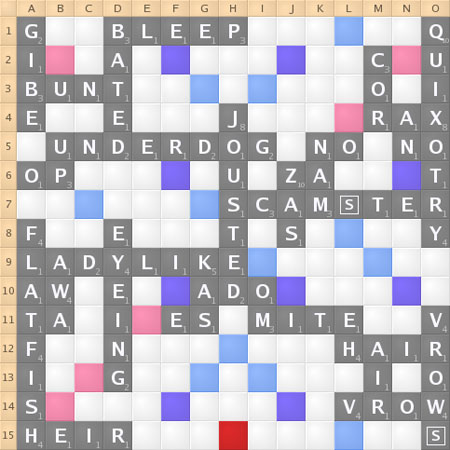
Scrabble has to be one of my favorite board games. I've mentioned before of my liking many of the games offered on the internet, but Scrabble or it's variants, is one of my favorites. I mentioned before also that the site ITSYOURTURN.COM has an offshoot of the game called Jamble that my sister-in-laws husband and I have been playing continuously now for quite a while. So, when I saw this hyperlink in REDDIT, that directed me to this article in SLATE, I had to make the trip. A man, whom the articles states is an ordinary player like most of us, got the unbelievable score of 830 it sent shivers up my spine with the visions of glory that could be within the reach of even us mere mortals. Well not really, but the words he used are not the fancy schmanzie ones, but words like FLATFISH. I could have thought of a word like that. Read the article and dream on. THIS IS THE FINAL BOARD.


http://www.slate.com/id/2152255/

October 26, 2006


Today in 1881 the gunfight at the OK Corral took place in Tombstone, Ariz., as Wyatt Earp, his two brothers, and ''Doc'' Holliday confronted Ike Clanton's gang. Three members of Clanton's gang were killed; Earp's brothers were wounded.

Evening Sun


Evening Sun
Originally uploaded by Daníel Starrason.
Another great flick from flickr. The locale of the shot is Iceland.

October 25, 2006

John Williams, Itzhak Perlman,
Sinatra and Jobim

This is one very good video. Music by two great musicians. A mood setter and nostalgic. I have also included the very somber piece, The Theme from Schindler's List, written by John Williams and played by the greatest fiddle player of our time Itzhak Perlman. It is sad and evocative of unbelievable cruelty, but the music and musicianship is superb. Take a few minutes and enjoy.

October 24, 2006


Bob Kane, the cartoonist who developed Batman, was born this day in 1915.
Born 10-24-1915 Died 11-3-98


Born in New York City, Mr. Kane attended Cooper Union and the Art Students League. His first comic strips, ''Peter Pupp'' and ''Hiram Hick,'' were published in 1936.
In 1938 he started drawing adventure strips, ''Rusty and His Pals'' and ''Clip Carson,'' for National Comics. That same year, a comic-book hero called Superman appeared. Vincent Sullivan, the editor of National Comics, who also owned Superman, asked Mr. Kane and Mr. Finger to come up with a Supercompetitor. They developed Batman on a single weekend. Mr. Kane was 18.

The first Batman strip came out in May 1939 in Detective Comics, one year after the debut of Superman. Batman's first adventure was called ''The Case of the Chemical Syndicate.'' And he was another kind of superhero entirely. Batman wasn't as strong as Superman, but he was much more agile, a better dresser and had better contraptions and a cooler place to live.
He lived in the Batcave, drove the Batmobile, which had a crime lab and a closed-circuit television in the back, and owned a Batplane. He also kept a lot of tools in his utility belt, including knockout gas, a smoke screen and a radio.

The above is a portion of Mr. Kane's obit from the New York Times.

October 23, 2006

I grew up in the forties, and early fifties so I remember listening to a lot of programming on a big Philco radio. After school serials were favorites. The following little story was a little fantasy trip back to those days.

PETE AND THE BIG PHILCO


“Boy oh boy, what a really rotten day”, Pete was thinking, as he opened the side door, really glad to be home. After days like this I can’t get home soon enough, he thought. The day started out bad when my mom, who was heading off to work in the defense plant, called me to get up as usually does.

“Yeah mom, I’m awake”, I said. Not true.

A half hour later the eyes pop open and I know something is not right. It’s too quiet. Mom has gone to work, I know it, and I’m going to be late.
I leapt out of bed and sure enough she’s gone. It’s going to be a bad day.

There were no surprises. I had to go to the principal’s office and explain why I was late. In my rush I forgot my homework and my teachers were not pleased with me. At lunch the cafeteria served Spanish rice, not my favorite. And if the day wasn’t going badly enough, at recess it was decided by Clench, the school bully, that I would be his target for the day. But one good thing happened, evidently Clench was off his game today and only pushed me down on the ground three or four times. That seemed to satisfy him and my life was saved.

And then finally, at three thirty, the dismissal bell rang and my terrible day was over. When I arrived home to a little peace and quiet, I threw my books down, poured a glass of cold milk and globbed some peanut butter on a couple of fold-overs. I sat myself down in front of our big Philco floor model radio and turned the on switch, and finally I was able to take a long breath, and get ready to enter the world of Jack Savage.

The big radios dial lit up, and I started twirling the dial. The radio was supposed to be a transatlantic model, able to pull in far away stations. But I wasn’t really interested in what was going on in Borneo, so I spun the smoothly spinning gold dial to Jack Savage’s station.
What the heck is wrong now, I thought, as the dial seemed to hit an obstruction and stopped well before Jacks station. I thought, well the dial spins both ways so I spun it in the opposite direction. Whatever it takes, I thought. Clunk. It stopped again at the same place as before.

As I sat there pondering my dilemma, something strange started happening. I seemed to have fallen into a daze. What the heck is happening to me I wondered, as the room seemed to be spinning and I seemed to be spinning too. Am I getting the flu? Holy Mackerel, I yelled, I was spinning faster and faster until all of the sudden the spinning stopped and I found myself deposited in a land of people wearing colorful sheets. Holy cow I thought as I finally recognized them as kimonos. I was standing near an empty aircraft hangar, when all of a sudden I heard a voice call to me as quietly as he could. “Pete, over here. Come quick”.

It was Jack Savage and he was beckoning me to hurry.

“I’m glad to see ya pal”, he said.

I looked at him questioningly. “Jerry, my sidekick, got sick halfway through the show and I need someone to help me complete the mission”.

I don’t have a clue what he’s talking about, but he’s not smiling and seems quite serious, so I’d better get serious too.

“Now here’s the deal, in the next couple hangars there are about twenty Jap zero’s and they’re scheduled to sortie over Midway tomorrow morning. Our fighters will be there also and could probably handle these devils, but it’s our mission to make sure we ground some of these airplanes to make it a little easier for our pilots. We’ll have to hide out here until tonight, then we’ll remove and destroy as many of these little pieces from their engines,” he said showing me what I think was a condenser. “They’ll have replacements for most of them, but maybe not all of them, and hopefully we can keep a few at least out of the sky.”

Night fell and we were busy completing our mission when we were sighted by the notorious super villain Dr. Ito just as we were finishing sabotaging the last airplane. Jack yelled for me to run for my life, and the two of us dashed for the exit. The hangar was huge and we were running as fast as we could, but Dr. Ito’s band of bad boys were hot on our heels. I was running out of breath and was afraid it was lights out for me and Jack, when my vision started to blur as before and I seemed to fall and started to spin round and round before I blacked out.

I awoke at home in front of the Philco just as Jack Savage was giving his normal signoff; he was thanking all for listening and was giving a special thank you to Pete Johnson for filling in and doing a great job. I shook my head and smiled as I thought, what a dream that was. I was still smiling when I looked down and saw my oily hands and soiled clothes. Holy cow I thought.


2006 jim kittelberger

October 21, 2006


Today, October 21, 1858 the Can-Can was performed for the first time in Paris, France.

October 20, 2006

A song by Gale Garnett starts like this:

We’ll sing in the sunshine
We’ll laugh everyday.

Along with your one a day everyday vitamins, and your slug of orange juice, a great way to start your day is with a dose of good humor. I do believe that in order to get through this life without having a flare up of mental misery, you need to have a sense of humor, and along with that sense of humor an ability to bend when circumstances change, to be able to adjust when things don’t go according to how you think they should. Like the proverbial tree, be able to bend with the circumstances or surely you will break.

Being able to laugh at ourselves is an absolute necessity. The moment in our lives when we discover that we are not very important in the grand scheme of things is an epiphany of sorts and a bitter pill to swallow for some. But in a way it sets us free, free from taking ourselves so very seriously. Free from thinking that every word we might speak is going to be taken down and printed in future history books. Sorry to tell you, but it’s not I’m afraid. I believe that our words will blow away with the wind we generated saying them. But that’s o.k. It gives us the freedom to speak our minds or any other sort of gibberish we want and not have to worry about it being quoted. It’s a load off of our intellectual reservoir, which for most of us may not be too deep.

So loosen up and read this little joke and enjoy your day.

A group of chess players were standing in the lobby discussing their recent tournament victories. After about an hour, the manager came out of the office and asked them to disperse."But why?", they asked, as they moved off."Because," he said, "I can't stand chess nuts boasting in an open foyer."

October 19, 2006


I finished reading Mitch Albom’s current book entitled, FOR ONE MORE DAY.

It is a small book in size, about half the size of a standard book and only about 200 plus pages at that, one of those books if it is any good at all that you can finish in a few hours. I finished it in a few hours. I originally wanted to read the book because the title intrigued me and I had enjoyed his first book, TUESDAYS WITH MORRIE.

The premise generally asks the question, if you could spend a day with someone who has died, what would you ask him or her, or tell him or her? It is a proposition that anyone who has buried loved ones would jump at, I think. I’ve buried both my parents, as has my wife, and I have many questions about specific issues that will forever remain unresolved. But would I treat my personal ‘one more day’ as a Meet The Press question and answer time, or would I just pick a day to relive one more time? I don’t know.

When my mother was dying and she somehow knew she was, she told my wife to tell me if I wanted to know anything about her, now was the time to ask. Out of good manners, or reluctance on my part to possibly cause any more traumas than we were already dealing with, or running into a bad case of becoming tongue-tied, I didn’t ask anything. Yet there are things I would have liked to know. But to sit there in front of her and quiz her like a suspect in a police station, I could not do it. In actuality we probably know the answers to most of our unasked questions, maybe we just want to hear it said, or not said, aloud.

Get the book from your library, or if you’re flush with funds, buy it. It will at least give you pause and something to think about. I’m still thinking about it.

October 18, 2006


What do you do when you have run out of places to browse?

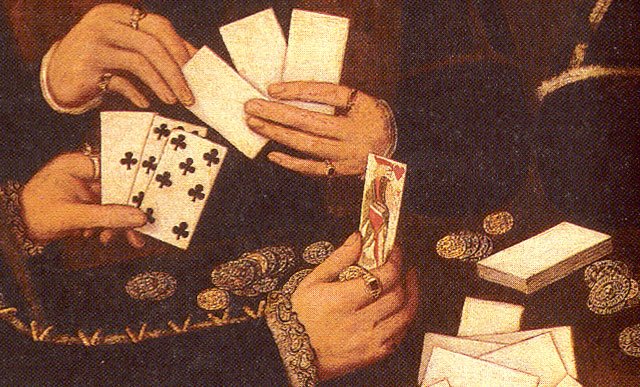
I’ll tell you where I go; I go to a game. Now I’m not what they call a gamester, one of those really serious, play hours on end, kind of a game player. I play what I suppose would have been called in years past as parlor games. Once years ago I was given as a gift from my sister-in-law and her husband two great CD ROM’s marketed under the well-known name of Hoyles card games and Hoyles board games. I have played games off of them for years. My favorites are spades, hearts, and gin rummy, they have many more, but those are the few I can play over and over again. In the board games my favorite is the old game Pachisi. These games are the sort that, at least to me, never gets tiresome.

That same husband of my sister-in-law and I have had a running game of chess, along with a game called Halma, a game something like Chinese checkers, and an off-shoot of Scrabble called Jamble on a great game site called ITS YOUR TURN. I make a move and click send, it goes to him, he makes a move and hits send, and that’s how it goes.

I admit I am a sap for some games that defy explanation of why do I like doing this. One of the current ones I do that fall into that description is a game called HELICOPTER. All you do is keep a helicopter in the air by missing walls that turn up on your course. It’s very simple and perhaps I am too because I love playing the game.

Another game that takes me back to my younger days is PINBALL. It works exactly like, well pinball. Turn the sound on and you’re back in the neighborhood malt shop or gin mill.

October 14, 2006


While scanning a list of Jerry Seinfeld quips, I came across this one:

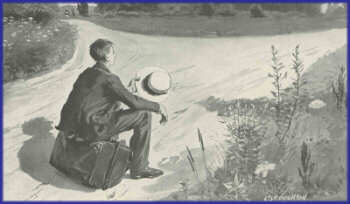
Sometimes the road less traveled is less traveled for a reason

That's clever, but also insightful. When you reach a certain age in life the thought must occur to almost all of us, did I make the right decisions when I had to? It did to me again recently. In my case fortunately my moments at those crossroads were few. When I rethought what may or may not have gone on at the moment of my personal decision-making I was satisfied that I probably made the right decision for me. I’m glad though that I had put myself into such a position at those times of decision, for if nothing else it signified to me that I had some control over my destiny for good or naught.

I believe that when we come to that moment of decision we make the right decision helped by an inner voice that knows us best. A no nonsense voice that knows innately the amount of courage we have, or common sense, or actual ability to carry out what we are proposing. It’s got us down cold. Sometimes we role-play within ourselves, but the inner voice has the ability to cut through the hubris or our self-made hyperbole and cut us short.

Some of us will display courage and take the chance and succeed, and those I applaud. The rest of us when we reach that certain age in life and have time to reflect will have made peace with our choices. After all we can’t go back and undo anything, and with most of us, our arthritis or other age related add-ons would make the journey too much for us.

October 13, 2006

casablanca's airport scene

I love this film, but it contains one of most sexist lines in all of moviedom. Rick tells Ilsa she won't be able to understand what he's saying , but after thinking of it for a while she probably will. Not a today kind of line, but stangely it was in those times. But as I've read about the movie, it was rewritten almost daily, so maybe not a lot of thought about Ilsa's lack of intelligence was considered. Anyway I loved the film and smile everytime I see this part of it.

October 12, 2006

Who's on First?

When I was a youngster I loved to go to the movies each Saturday morning. My favorite funny guy was Lou Costello of Abbott and Costello. He was the one character kids could relate to I suppose. He was always a little slow on understanding what was happening but it always worked out in the end. I read recently that the pair made tons on money during the war years, (WWII) but they both lost it all to the IRS and died pretty much broke. Here is their famous routine, WHO’S ON FIRST. I have seen it so many times, but I laugh each time.

October 11, 2006

HAPPY BIRTHDAY ELEANOR ROOSEVELT
October 11, 1884-November 7, 1962

October 10, 2006

ELDERLY-MAN: An Adventure
By Jim Kittelberger


What the heck do you do with yourself all day?

If you’re retired, you’ve heard this question a dozen times. I
Sometimes wonder the opposite, what did I do before I retired.
Since retirement, wonderful new worlds have opened up for me,
Almost like a renaissance of a sort. My wife and I, separately or together
Seem to need more time each day to do whatever it is we do.
Of one thing I’m certain, each day brings that feeling I used to
Get when I had a snow day off from school, unexpected freedom
From worry and stress, at least for another day. Except in retirement
It is every day. How many times during your working life, did you
Look outside and see the snow piling up or the rain coming down so
Hard you knew you’d drown in it, and you wished you could just put
On another cup of coffee or tea and open a book and settle in and
Ignore the outside. Well we do have that freedom, and the feeling
Is exactly the same, wonderful unscheduled time to go where ever
Your heart and mind leads you.

What you have read above is exactly the way it should be. You have worked hard and earned your time for relaxation, travel, or whatever you most enjoy. It is not the time to be taken advantage of. If you and/or your spouse have a problem you cannot handle because of your age, contact me, elderly-man and I will set it right and I will enjoy doing it. I can be contacted at the following number. When life no longer seems fair, contact Elderly-Man and he will make the difference.

Till then,

Elderly-man stands ready to fight all foes, right any wrongs,

“What the devil are you doing Bruce?” Her brittle voice jolted him back to reality. “I thought I told you to take the garbage out; it’s starting to stink, and when you get done with that I’ve got something else for you to do,” exclaimed Helga, exasperated once again at having Bruce under her feet all day now since he retired and losing patience with his ineptness at almost everything he has tried since then.

Well, in real life I’m not exactly your everyday superhero, but in my mind I could live a different life, Bruce thought. For example, just yesterday as I was running an errand to the supermarket, I witnessed a bus driver berating an elderly woman about being too slow to exit his bus. I morphed from Bruce into elderly-man and presented myself at the bus door. As I stood there looking in, the driver in his most bully-loud voice asked if I was sightseeing or was I getting on, I was holding up his schedule. In my greatest duke/clint walk, I entered his bus, and to the drivers great surprise and subsequent fear, lifted him out of his seat by the lapels of his jacket, and proceeded to educate him about the etiquette required from him from this point on to all senior citizens. Further, if I got any report of his belligerent talk, and impolite attitudes, he would be eternally sorry. Of course, he cringed like a beaten dog and acknowledged his wicked ways and promised to correct them. I smiled the smile of righteousness and thought it would be nice and proper if he stood and apologized to all his passengers for his misdeeds, which of course he did. The folks on the bus gave him the look that promised if he did not change they would again contact elderly-man and he would be forever sorry. Then they all stood, smiling and applauded him for his good work. Elderly-man puffed out his chest, smiled the smile of right and good, gave them a wave and off he went, another bad mannered ruffian set right.

“Well,” she shouted, “are you going to do what I asked or do I have to do everything around here? You’re such a wuss.”

Oh if she only knew, he thought, and he smiled that elderly-man smile.

October 9, 2006

My daughter and her husband visited yesterday and in the course of conversation we decided to drag out a photo album. It's something we have not done in a long time. While looking at the pictures we came across a few of her great grandparents whom she never had the good fortune of meeting. It brought back many a good thought to me and a few rembrances which I passed along to my daughter. I wrote this little essay years ago, and thought I would post it today as my memories again are renewed of them and, it just occurred to me after all these years, a trait they shared, their complete lack of self. From my perspective they were always giving. It's like I just discovered something I always knew inately, but never until now understood personally what makes some people lovely human beings. I apologize for my babbling.

GRANDMOTHERS
An essay

By Jim Kittelberger

I was blessed with two grandmothers who defined what grandmothers are. One was of ‘English’ heritage and the other German. Two different types you could not invent. Circumstances had a lot to do with it, my English grandmother whose name was Anna was a tall straight woman who in her entire life never had an excess ounce of weight on her frame. When I saw pictures of the tall spare women who left their homes in Oklahoma during the depression and headed for California, who looked like all hope had gone out of their lives, I was always reminded of my dear sweet Grandma Anna. Her life I fear was not happy. She was involved in a dysfunctional marriage before the term was even invented. Consequently it was only Grandma Anna and no Grandpa. She had very few worldly goods and, of course, nothing to give to a little grandson except her quiet love. She gave that in abundance and I remember her fondly.

The complete opposite to my English grandmother was my German grandmother whose name was Barbara, who ran a home filled with people, good food, lots of hugs and a Grandpa who was a typical German immigrant, a big man who sat in his chair and smiled at me but didn’t waste too many words on me. Grandma, a short stout woman who looked strange whenever I would see her without her apron on, cooked, baked, and raised three girls and a boy in a house with two bedrooms and a toilet in the basement and washtubs for baths. It was a home always filled with the good smells of fresh chickens being cooked and strudels, kipfels and other delicacies being baked. She handled a knife with the adroitness of a magician, slicing through dough for homemade noodles and then swinging it around to illustrate a point in a conversation. I loved being around her, and even as a child I knew the significance of her habit of squeezing my face and calling me butchalee. A term with no meaning in the English or German dictionary, but I knew without doubt that it signified love.

Now, I am married to a Grandmother. She, like all women, one day without fanfare, or realization of time gone by, find they are suddenly grandmothers. They almost seem to have been implanted with a grandmother-chip, they start doing things that their mothers did when they became grandmothers. Whenever the grandchildren show up at our house, she cannot let them go home without a bag of leftover food, or candy, fruit, or whatever. As the kids are starting to go out the door, she will be flitting here and there depositing things in that bag. It’s a tradition, or maybe just a thing that grandma’s do. A word for all grandmothers or prospective grandmothers, keep up the good work because the little kids will remember forever. Look at me, I’m ancient and I still remember my grandmothers with love, and a smile.

October 7, 2006

THE COMMON SCHMUCK


I didn’t know it, but my eyes were blinking rapidly as I entered a state of REM, that state of sleep where you dream your dreams. Mine, wouldn’t you know it, mimicked my real life, a life I had screwed up royally time after time. Finally my eyes opened a slit and moved toward the red LED of the bedside clock shining brightly, too brightly. It must still be the middle of the night. Yet when my senses cleared, I was aware it was morning; the unbroken grayness at the window told me it was going to be another crummy day of clouds, and God forbid, more rain. Maybe I’ll just close my eyes for a couple minutes more. Perhaps when I awaken again, it’ll start out better. I’ll feel more rested, the sun will be shining through my window, I’ll be anxious to jump out of bed and prepare myself for another day of commerce in a job that I would enjoy even if they didn’t pay me a cent. I would be working in a career, not a job, a career that I had chosen and trained for through college and postgraduate school. A job I was good at. No, not good at, but excelled at. A job where I was recognized for what I knew and contributed. Oh yeah. Dream on chump. Dive back into those REM’s, because that’s the only place that will ever happen.

I dragged myself out of my uncomfortable bed, (purchased used at a second-hand store) glanced at the wrinkled mess and thought for a moment about making it. But then using the uncluttered brain I was given at birth, a brain that has stayed pretty much empty and unencumbered by serious gray matter thus far in my life, rejected the idea as busywork without reason, muttering to myself, “Nobody is going to see it,” the classic answer of the single or divorced man.

Yeah, I had botched that also. I once had a wife, a very nice wife as it were, a wife I wore out mentally after what she described as five long years of baby-sitting a grown-up walking migraine. My constant complaining, my constant harping on life’s inequities and my position at the short end of the stick finally drove her muttering, and shaking her head, back to her kith and kin, seeking relief and rehabilitation with ‘normal people’, she yelled as she exited my life.

As I sat at my Formica kitchen table set, one of the three pieces of furniture left to me, I poured milk into my cereal bowl. “Is that milk sour?” I muttered to the empty room. A habit I seemed to have developed recently, talking to my surroundings. I didn’t have time anyway to finish eating my corn flakes, the last box of my Post ten selections. I quickly snatched at my bowl, too quickly, and the milk sloshed out baptizing half of my tie collection. “RATS,” I exclaimed saving the bluer language for those jerks on the beltway. After quickly exchanging my foul smelling, sour milk anointed tie for the only tie I had left, a red Christmas novelty tie featuring the Grinch in various Christmassy poses, I headed for the old junker and the beltway.

Arriving at work. WORK-that place that occupies most of a persons day, at least eight hours on the job; an hour getting ready to go to and traveling there; another hour going in reverse back to home; and if you are lucky eight hours of sleep. Let’s see, that’s eighteen hours, which leaves six hours to do whatever you really want to do. So it is fairly obvious since we spend so much time working and in work related activities we really should love, or at least, like what we do.

Most of us I'm sure do not end up in jobs of choice, but in jobs we fall into by circumstance of good, or bad luck, however it works out. The truly happy worker is the person who knows, has always known, what he/she wanted to do with their lives, and prepares for that profession in college and maybe postgraduate work. Or there is another group who I think enjoys what they do, and that is the entrepreneur, that person whose success is solely a result of his talents and drive. Either group of people is happy in their work because subsequently they are in charge of their own destinies.

But now, back to Mr. Schmuck.


I no more than got in the door when an office memo was shoved in my face. A sales meeting would be taking place at nine o’clock; your attendance will be required. “Oh my God, not another one of the most boring time-fillers created by the midget brains in the home office”, I exclaimed to anyone within hearing distance. Why those guys in the home office make that big money yet bore us with this stuff is beyond me, I thought. Don’t they have any idea what we need to succeed in the field? Well we’re the backbone of this company and we’ll survive and prosper despite those bozos.

Well now that they’ve wasted most of my best selling time with their blabberings, I might as well head for home, I deserve the rest anyway after what they’ve just put me through. Anyway if I get on the beltway now it won’t be quite as busy and I can get home sooner to..do what? I don’t know but I deserve the extra time-off anyway.

Thus ends the workday for our common schmuck.

“I wonder if I should change my sheets? I think it’s been two weeks since I have, or is it three weeks?” I mutter to myself, and then decide to put it off a little longer, because actually who’s going to see them anyway?

© jim kittelberger 2006

October 6, 2006


THE SPIDER'S WEB
By Jim Kittelberger

When the suns direction is just right,
and if it's within your sight,
a long days toil of insect small
will appear from ground to wall.

A web of tiny strings is all,
measuring to human head tall and
designed to capture creature small.

Yet as best laid plans sometimes go awry it's said,
its work bedecks my head.

October 4, 2006


AUTUMN IS A MELANCHOLY TIME


Autumn is a melancholy time
a time of yellowing and falling
leaves. A time of beauty and
quiet.

Of man and beast preparing to face
winter, the harshest season of all.
The season of silence and introspection
a season to dwell on deep thoughts,
a time to foster friendships deep.

Yeah right!

it’s cold and wet
and stinking nasty.
My feet are cold, my nose is
running faster than my car which
has a frozen radiator.
Ice has formed on all my trees,
and loud snaps threaten me with
the sounds of timber as they
fall and bring my garage to the ground.

Yet it is a serene season,
a season to reflect on all the
good things of nature.

Yeah right again!


© jim kittelberger 2006

October 3, 2006

ALMOST THERE
By Jim Kittelberger

The door slams behind me, loud in the quiet night,
Winter moonlight bathes the tundra
Work boots crunch a frigid cadence
Diamonds in the snow sparkle its fools gold
Do not linger
Silent eternity awaits the foolish
The cold invades my clothing
Quicker the crunching sound
I must hurry; I must hurry
The wind arrives unexpected as death
Snow swirling, envelopes me in white sheets
I’ve lost my way, make a quick back track while I may
Tears spring unbidden from my eyes and turn to ice
I must hurry
My tracks are being covered, but I know it’s this way
Yes I know I’m right
Crunch; crunch
Quickly, the enemy panic arrives
Faster; faster
I can’t see, should I go ahead, or back or
Oh God, help me
I’m so tired
There, under that tree I’ll wait
I’ll wait and think
It has to stop soon
I’ll rest and wait
I hope my love will forgive me for being late
I’ll just close my eyes for a moment

October 1, 2006


I don't know what to think of people who risk their lives for a thrill or notoriety, like Earhart, or the guy who jumped his motorcycle over a canyon, Evel Knevel, and Lindberg. But they make our lives interesting none the less. Here is a chronicle of her last stunt in 1937, written by Keri Rumerman.


What turned out to be the final flight of Earhart's career, and, ultimately, her life, began on June 1, 1937. Earhart and Noonan left for their round-the-world flight from Miami, Florida, in her twin-engine, red-winged Electra. From Miami, they flew to San Juan, Puerto Rico. Right before taking off on this leg of the flight, Earhart was quoted as saying, "I have a feeling there is just about one more good flight left in my system and I hope this trip is it. Anyway, when I have finished this job, I mean to give up long-distance 'stunt' flying."
As Earhart's journey continued, news of her flight made the front page of newspapers around the world. She sent reports of the land, cultures, and people she encountered. On June 30, 1937, Earhart and Noonan arrived in Lae, New Guinea. They had traveled 22,000 miles (35,406 kilometers) and had 7,000 miles (11,265 kilometers) left to go.
Their next destination, and the most dangerous stop of the trip, was Howland Island, a tiny island in the Pacific Ocean, 2,556 miles (4,113 kilometers) away. Before Earhart took off from Lae on July 1, there was confusion about which radio frequencies were to be used, which remained unresolved before she took off. As the scheduled time neared for Earhart to approach the island, several transmissions were received from her, demanding to know the weather. A new weather report describing heavy clouds and rain northwest of Howland had been issued, and Earhart had apparently run into the storm. Earhart transmitted several more times but never reached her destination, disappearing somewhere off the coast of the island. A large search party was quickly organized, but no remains of the crew and the plane were ever found.
There are many theories surrounding the controversial disappearance of the plane on July 2, 1937. The most commonly accepted theory is that the fliers got lost, ran out of gas, and went down somewhere in the Pacific Ocean. However, as war between the United States and Japan was imminent, there were rumors that Earhart had been on a spy mission for the United States and was supposed to photograph Japanese military installations. This theory says that she crash-landed and was captured by the Japanese, who imprisoned or executed her. A third theory was that her disappearance was staged to allow the U.S. Navy to conduct a search in the South Pacific.
Although only 39 when she disappeared, Earhart accomplished a great deal and is considered a true hero of the 20th century, especially for women. She demonstrated courage, integrity, and an independent spirit. She used her fame to advance the cause of women and showed that a determined woman could achieve anything. Her efforts led a generation of women to seek new horizons and new roles for themselves.
--Keri Rumerman